Practicing meditation, which we call sitting, is how we begin to actualize Buddhism in our lives. Our style is zen meditation, a silent practice. Simply put, it is sitting light, tall, and soft, with all your dignity, breathing in and out through your nose. It is practicing being natural, allowing the part of you that uses language to rest, and getting to know who you are when you’re not trying to be anyone.
There’s nothing to achieve and nothing to attain.
Practicing meditation together with others is the foundation of sangha, a caring, mutually supportive community. When combined with living by the Sixteen Bodhisattva Vows, it is a powerful practice that leads to clarity and acceptance, a path to a quiet place beyond bitterness where we may tend to our broken hearts and be free, together. This is the threefold learning (tam học, 三學, triśikṣā) both practiced and taught by Śākyamuni Buddha: sincere living through vows, meditation, and clarity beyond words and ideas.
The steps are:
- Find a clean, quiet place, ideally with other people who are practicing.
- Sit light and upright and let your muscles soften a little bit.
- Take a breath, and allow the breath to return to the air.
- Allow your language-mind to rest and let words and concepts get out of the way.
- Start all over again.
Step 1: Find a clean, quiet place, ideally with other people who are practicing.
Why practice meditation with other people?
Practicing meditation together with other people is very important. Sitting with others is the simplest practice of cooperation and care. Without saying a word, when you practice wholeheartedly and sincerely, you support others while receiving their support at the same time. Over time, this same attitude becomes a part of you and follows you into all of your relationships. After all, you are the same person both on the cushion and off. It can also be a lot of fun!
Online practices are wonderful and so are in-person practices. Why do we host practices every day? Because the effects of organizing your life around daily practice are profound, and we are here to make that as easy as possible for you and for all of us.
When you join our in-person practices, our Practice Leaders take care of placemaking and timekeeping so that everyone can be together and practice without trouble. May through October, we practice under big shade trees on the grass, in the company of people, both human and non-human. When everything around is being natural, it’s much easier to be natural ourselves. In colder months, we practice indoors, doing our best to be able to see the sky.
Tips for Practicing Meditation at Home
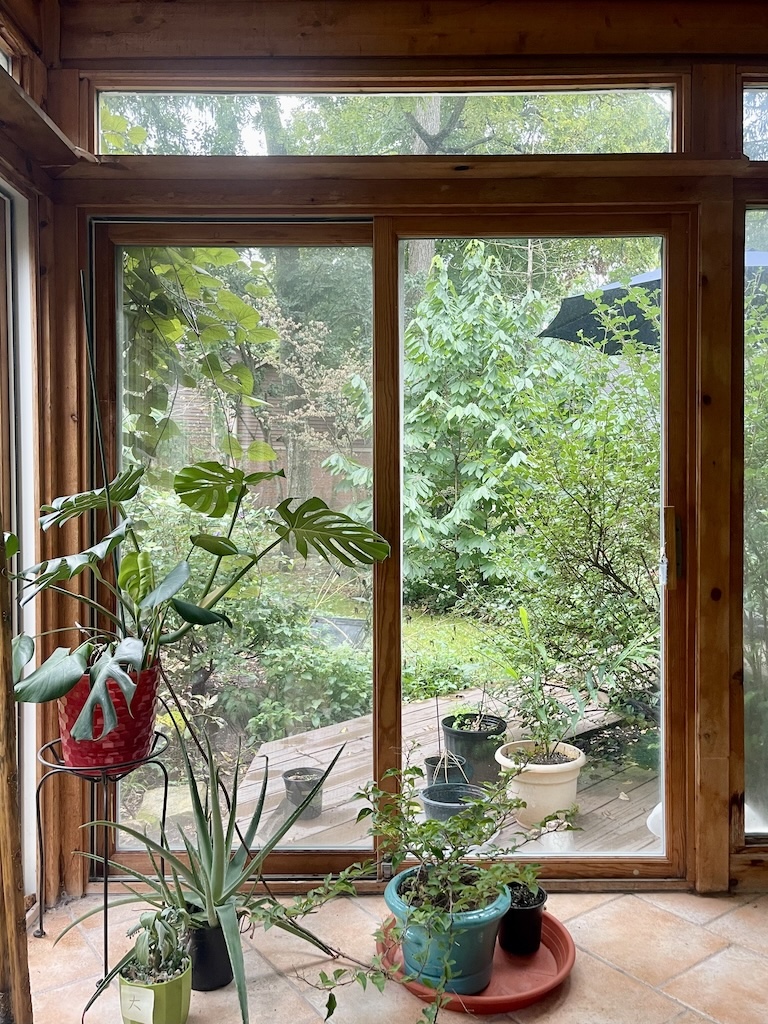
At home, you may enjoy sitting facing the outdoors. I sit in a glassed-in sunroom facing my back garden. Lots of animal siblings come to visit. It can be challenging to find a spot free of word-noise (both visible and audible) and clutter. Do your best. No place is flawless. Have a lot of clutter? Try the traditional zen practice of sitting near a blank wall and facing it with your eyes open.
Zoom Practice
It’s ok to have your camera either on or off when attending one of our Zoom practices. If you keep it on, please sit so that you are not facing the camera, but offset at least a little bit. (When you face the direction of your camera, to everyone else it can appear that you are looking right at them, even when you aren’t.) The Practice Leader keeps time, invites the bell, and manages the virtual practice space to make sure that everyone can practice there without trouble.
Step 2: Sit light and upright and let your muscles soften a little bit.
Your physical posture and your mental posture reflect and influence each other while you practice meditation and all other times.
Seat
Arrange your body so that you can sit with your back light, upright, and free. For some, that means the traditional way of sitting cross-legged (even in half-lotus or lotus) on a cushion. For others, sitting in a chair with the feet on the ground is the way. Some use a meditation bench or turn a cushion sideways and take a kneeling position. Others lie down. You’ll learn what your body needs with practice.
Posture
Please sit with dignity, light and tall in the upper body, ears floating above your shoulders, and allow your muscles to soften a little bit. While you sit, you may realize when your body has strayed from this. When you do, take a breath and ease back into the starting posture. Do your best to allow your body to be still. Your physical posture and your mental posture reflect and influence each other. Avidya, or ignorance, is literally looking away. One aspect of practice is easing towards whatever is right in front of you, no matter the obstacles.
Hands
Traditional position: rest your right hand, palm up, in your lap up against your belly, then rest your left hand, palm up, in your right palm and allow the tips of your thumbs to rest against one another. Your thumbs resting in this way may allow your shoulders to relax.
Eyes
Traditional: eyes open. There are reasons why this is traditional, but you may try practicing with eyes open and eyes closed, observe the effects, and practice as you like.
Step 3: Take a breath, and allow the breath to return to the air.
As long as we’re breathing, there’s a chance.
Breathe in and out through your nose. Breathe in all the way down to the spot below your belly button and let your belly and chest fill. When you let go, your breath returns to the air effortlessly. Please allow your in-breath to lighten your posture, and allow your muscles to soften a bit when you let the breath go. Sitting with ease, breathing with ease, and being at ease are related.
Breathing in, this is breathing in.
Letting go, this is breathing out.
When I start my meditation practice, I inhale to the top of my breath — the point where breathing in deeper involves a lot of effort — hold for a couple of heartbeats, and release. I might repeat that a few times before releasing my attention from my breathing. This helps me relax when I feel upset, agitated, or nervous as well. You can also try squeezing down at the bottom of your exhale instead, holding, and letting go, allowing air back into your lungs.
I personally do not pay special attention to my breathing during meditation practice, other than to keep it moving if I notice my breathing is stuck. Some people like to focus on breathing by, for example, counting breaths, concentrating on feeling the breath at the tip of their nose, or controlling the pace or length of either the inhale or exhale. I think that it’s ok to practice those sorts of things, but I’ve found that it’s important to know when I am using such practices to distract myself, or to give myself something to do. Concentrating on any object can become a practice of ignoring everything else. Concentration and meditation are not the same thing.
Step 4: Allow your language-mind to rest and let words and concepts get out of the way.
What are words?
While you practice meditation, you may notice that your thoughts take the form of words. You might hear words in your mind during sitting just as you may be hearing these words as you read. This is a capacity of the mind: taking the boundless depth of reality and intellectualizing things by flattening it into tidy little concepts, grasping at explanations by trying to connect those little dots together into narratives, and spinning more stories until we’re totally ensnared. Who hasn’t carefully protected a web of ideas that they hold dear? (e.g. ideas about who you are, aka ego)
Words aren’t all bad — after all, words are a way we can transmit what is in our heads to each other and perhaps clarify specific things — but in our culture, it is common for people to casually mislead others (e.g., all advertising and “people pleasing”) and to only accept something as true if it fits neatly into stories one already holds. Words and concepts are, when used carefully, a reflection of a fragment of reality that gestures at reality itself so that we can see it directly: a finger pointing at the moon. Used carelessly, or with misleading intent, they present a distortion of reality. This is how we fool ourselves and others and perpetuate bitterness and harm.
Practicing Meditation Frees Us
Practicing meditation liberates us from that all of that. This language-mind, or thinking-mind, is like a fist that you can relax. Uchiyama Roshi, a Japanese monk who was the former abbot of Antaiji, called this Opening The Hand of Thought in his book with that title. I find it is just like allowing my clenched fist to soften a little bit. Returning to a light, tall meditation posture is literally embodying this. When you practice meditation this way, words get out of the way. Practicing going beyond words, you get to really, really hear and see beyond the ideas in your own head. This is prajñā (慧, tuệ or bát nhã in Vietnamese).
This is the subject of the (Prajñāpāramitā) Heart Sutra. When Avalokitísvara Bodhisattva practices meditation this way deeply for a while, they see that all phenomena are emptiness (interrelated causes and conditions), that grasping onto their ideas that don’t line up with reality is the root of suffering, and that it is possible to practice not-grasping. What they realize, put into practice, moves them beyond all forms of bitterness and grief. It frees their heart.
Avalokitísvara Bodhisattva is the Buddha Nature in each of us. Their full name in Vietnamese further reveals what this means: Đại Từ Đại Bi Cứu Khổ Cứu Nạn Quan Thế Âm Bồ Tát. In English, Great Friendship, Great Compassion (also Great Sadness), Reliever of Suffering, Reliever of Disaster, Avalokitísvara (Witnesser of The World’s Sounds) Bodhisattva (Awakened Being). It’s nice to know that this is the nature of every single one of us, the source of our dignity. Seeing this in yourself, you can’t help but see it in every person, every living being, all around.
Step 5: Start all over again.
Every breath is a chance to start again. While you sit, you may realize that your body has strayed from being light, tall, and at ease. When you notice this, take a breath and ease back into the starting posture. Your physical posture and your mental posture reflect and influence each other while you practice meditation and all other times.
Every time you practice meditation, you are tending to your ordinary heart, your Buddha Nature, practicing seeing with it and letting it be seen. It is a practice of being a truly courageous person, how we free ourselves and each other.
Thanks for reading! I hope we get to practice together sometime soon. See our practice schedule on the home page.
Tony