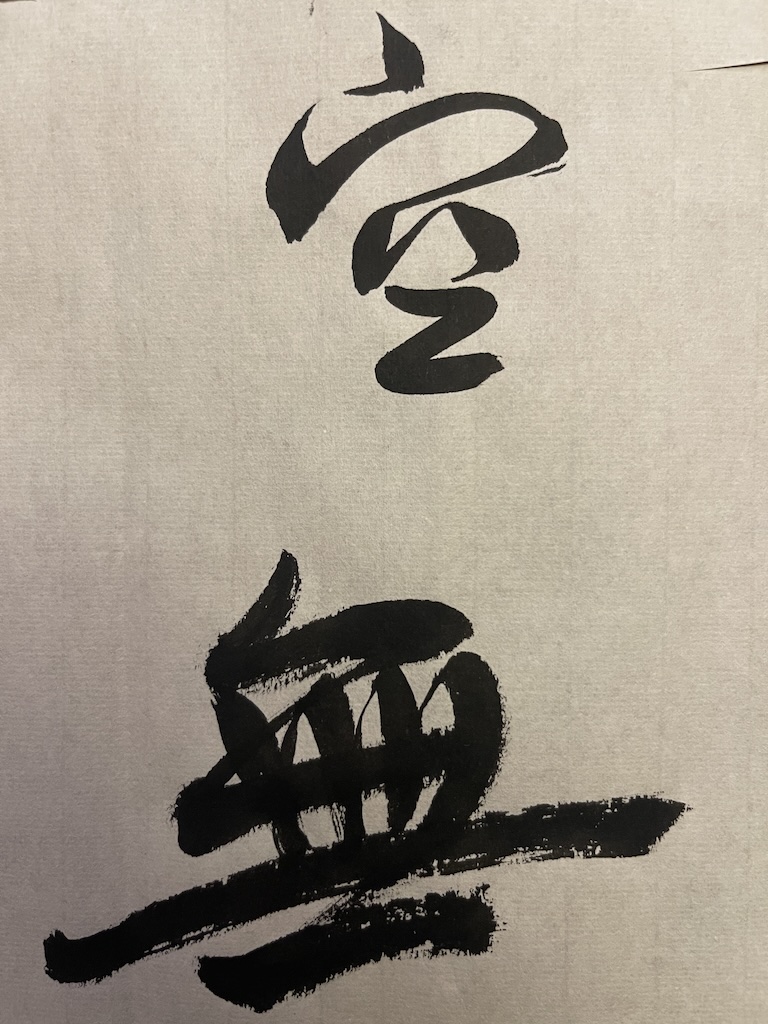
A translation of The Heart Sutra by Tony Nguyễn Wiederhold from the Chinese version T-251, written by the monk Xuanzang in the year 649, and the official Sino-Việt version of the Buddhist Sangha of Việt Nam, Ma-ha Bát-nhã Ba-la Mật-đa Tâm Kinh.
Note: the bolded section is what we recite after Ordinary Heart Is The Way at Sunday Practice and retreats.
The Heart Sutra is meant to be chanted. Here is a traditional Vietnamese chanting and a contemporary Vietnamese chanting. There are even “Gen Z” versions! Maybe someday we will set our version of the Heart Sutra to music.
Prajñāpāramitā Heart Sutra
Avalokitísvara Bodhisattva, practicing deeply prajñāpāramitā for a while, clearly sees that, in all cases, all five skandhas are emptiness and moves beyond all forms of bitterness and grief.
Shariputra, form is not separate from emptiness. Emptiness is not separate from form. Form is exactly emptiness. Emptiness is exactly form.
Feeling, perception, impression, and discrimination are just like this.
Shariputra, all phenomena are emptiness in essence.
Neither born nor gone, neither filthy nor pure, neither growing nor fading. Therefore, within emptiness, no form, no feeling, perception, impression, or discrimination.
No eye, ear, nose, tongue, body, or mind.
No color, sound, aroma, flavor, touch, or object of mind.
No sight awareness and so forth until no mind awareness.
No ignorance and also no cessation of it and so forth until no old age and death and also no cessation of them.
No Suffering, Arising, Stopping, or Path.
No knowledge, and also no attainment, all through the practice of no-grasping.
Bodhisattvas depend on prajñāpāramitā and the heart is unensnared. When the heart is unensnared, fears don’t exist.
Far apart from every delusion and illusion, one rests in Nirvana.
In the three worlds, all Buddhas depend on prajñāpāramitā and attain that which is unsurpassable: Collective Liberation.
Know that prajñāpāramitā is the great essential mantra,
is the great, bright mantra,
is the supreme mantra,
is the unequaled mantra able to remove all suffering and is true, not nothing.
So proclaim the prajñāpāramitā mantra. Proclaim the mantra that says:
Gate gate paragate parasamgate. Bodhi. Svaha!
Gate gate paragate parasamgate. Bodhi. Svaha!
Gate gate paragate parasamgate. Bodhi. Svaha!
(Gone, gone, really gone, altogether gone. Awake. Aha!)
Notes on The Mantra
Jan Nattier, through thorough analysis of both Chinese and Sanskrit versions, has shown that the Heart Sutra was composed in Chinese and translated to Sanskrit. According to her paper, the mantra appears in a mantra catalog, called Dhāraṇīsamuccaya (T901), that predates the Heart Sutra. There, the mantra is called 般若大心陀羅尼第十六 (Bát nhã Đại Tâm Dà la ni Đệ Thập Lục, Prajñā Great Heart Dhāraṇī #16). Note: what is commonly referred to as the mantra is technically a dhāraṇī. At this point I’m not clear on what the distinction is, but may update this one day if I ever learn.
Because it was composed in Chinese, one may wish to recite the mantra using either the Middle Chinese pronunciation, which is how the Chinese would have been pronounced at the time of composition, or in Vietnamese.
Anglicized Middle Chinese
kjot tejH kjot tejH pat la kjot tejH pat la song kjot tejH bu dej swa xa
Vietnamese
Both the Chinese and official Vietnamese versions have an extra word in the mantra, transforming Bodhi to Bodhisattva. This word is not in the source Dhāraṇīsamuccaya.
Yết đế yết đế, ba la yết đế, ba la tăng yết đế, bồ đề tát bà ha
For a summary of study on the mantra, please refer to Jayarava Attwood’s blog post on the subject.